
The question is: which one of the images above do you associate with the word Takete and which one with the word Maluma?
It is very likely that the answer associates Takete with the letter a and Maluma with the letter b.
This experiment on sound symbolism, the link between forms and sounds, was conducted in 1929 by Wolfgang Köhler and in most cases Takete is associated with the angular figure (a) and Maluma with the figure with a softer shape (b). Each word is received by the brain as an image, to which a meaning is subsequently associated.
Further studies conducted in different languages with fictional words, led to the same results. The fact that still remains quite mysterious is the perceptual process that brings to these results. It is not clear whether this happens more or less automatically.
A more recent study on the use of phonosymbolism applied to brand names shows that the phonetic structure of a name influences the consumer’s perception of a product.
It is truly interesting that the vowels, in all languages, are ordered in a sort of phonetic hierarchy (a, e, i, o, u) which corresponds to the position (from top to front to bottom to the back) and curvature of the tongue when we make the sound.
Sound and Images in Futurism
And with art, emotions linked to shapes and sounds also come into play.
There are countless artworks that we could define as loud. Especially in Futurism, thanks to the invention of Filippo Tommaso Marinetti, the word becomes free from syntactic rules and becomes visual art by exploring the link between form / sound / emotion.
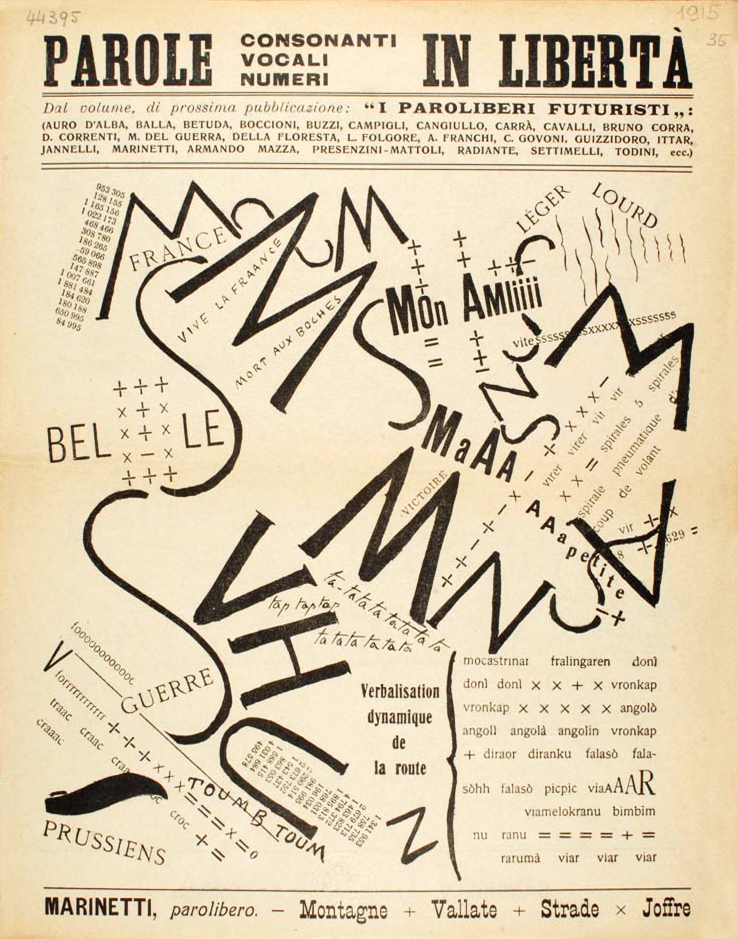
There are questions and questions, queries and queries, requests and requests. They cannot all be kept suspended in the anisotropic space of uncertainty by the same sign, by the same typeface. Each question requires its own specific, appropriate and … tailor-made, question mark. We study the form that this question mark must have to transform a banal flatus vocis into a mobilization of the brain.
Manfredo Massironi, L’Osteria dei Dadi Truccati
Per la Voce
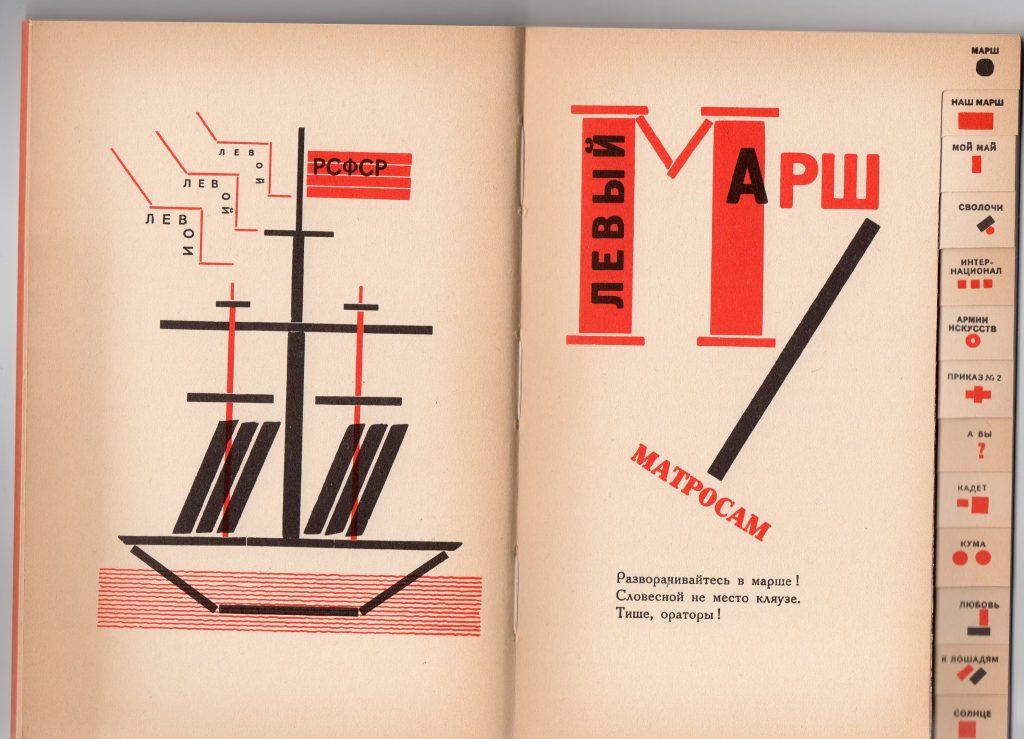
Another masterpiece of typographic art is the small book Per la Voce where 13 of Mayakovsky‘s poems are paginated and illustrated by El Lisitskij. The images printed on the left pages are illustrations of the texts shown on the right pages.
Pleasure is a psychological dimension that we associate with moments and experiences of our life including, not least, those concerning art.
Manfredo Massironi


